Category: Scoliosis Treatment

  • The Courage of a Thirteen-Year-Old Girl Who Refused to Let Scoliosis Define Her Life

    The Courage of a Thirteen-Year-Old Girl Who Refused to Let Scoliosis Define Her Life

    Standing Tall

    Home > Blog >Standing Tall

    The Courage of a Thirteen-Year-Old Girl Who Refused to Let Scoliosis Define Her Life

    The Girl Who Loved School

    At thirteen, Chandana was like every other girl in her class. She loved going to school, laughed with her friends during lunch breaks, and dreamed of becoming a teacher one day. Her school uniform was always neat, her homework was always complete, and she never needed to be reminded to get ready for school. 


    Then, one morning, she refused to go. 

    “I don’t want to study anymore,” she told her parents quietly.

    Her mother looked at her in disbelief.

    “What do you mean? You’ve always loved school.”

    “I’ve just lost interest.”

    Her father thought it was a passing phase.

    “Everyone gets tired of school sometimes. You’ll be fine.”

    But Chandana remained firm. She refused to wear her uniform, pack her books, or even step outside the house. Her parents tried everything—reasoning with her, encouraging her, even scolding her. Nothing worked.


    The Secret She Had Been Carrying

    After hours of gentle persuasion, Chandana finally broke down.

    “I can’t bear it anymore,” she sobbed.

    “The boys call me names. They laugh when I walk. 

    Even children on the street stare at me and whisper about my bent back.

    I don’t want anyone to see me.”

    Her mother was stunned. She suddenly remembered a conversation nearly a year earlier.

    “Amma, does my back look different?”

    At the time, she had glanced briefly and reassured her daughter.

    “It’s probably because of your heavy school bag. Don’t worry.”

    Believing her mother, Chandana ignored it. But the curve slowly became worse. At first only she noticed it. Later her clothes fitted differently. Soon everyone noticed. The whispers became laughter. The laughter became mockery. Classmates mimicked the way she walked. Children on the street made cruel comments. Each insult gradually weakened her confidence. She stopped looking into mirrors. She stopped making eye contact with people. Finally, she stopped going to school.


    A Diagnosis That Changed Everything

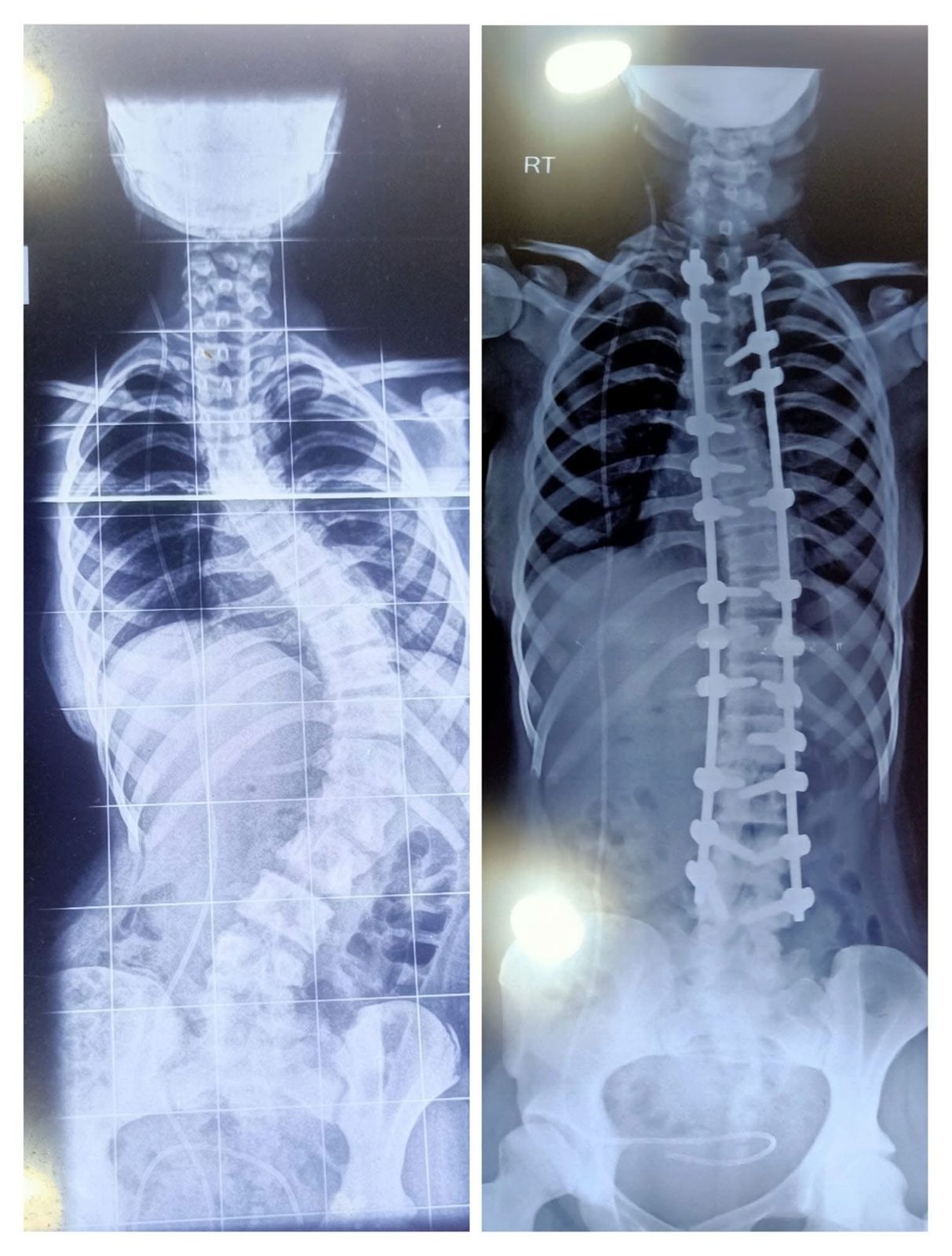
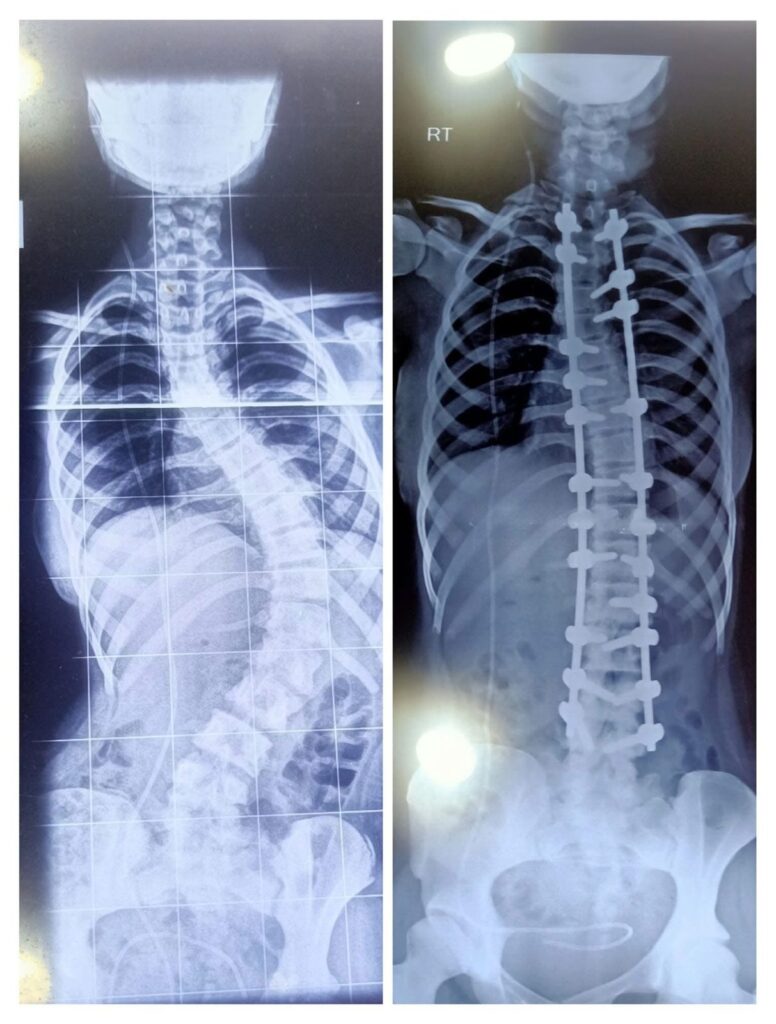
    Realizing how much their daughter had suffered, her parents consulted a local orthopedic specialist, who referred them to Dr. B. Leela Prasad, a spine surgeon. After a detailed examination and standing X-rays, Chandana was diagnosed with adolescent idiopathic scoliosis, and her spinal curve measured nearly 70 degrees.

    Dr. B. Leela Prasad explained that a curve of this magnitude was likely to progress further and recommended corrective spinal surgery. The word “surgery” terrified the family. They had expected medicines, exercises, or perhaps a brace—not a major spinal operation.


    Fear Versus Hope

    The family sought advice from relatives, friends, and neighbors. Almost everyone discouraged surgery.

    “It is too risky.”

    “What if she becomes paralyzed?”

    “She’s only thirteen.”

    “Let her live with the curve.”

    Overwhelmed by fear, her parents decided against surgery.

    When they told Chandana, she quietly asked, “So… I’m supposed to live like this forever?” 

    Her father tried to comfort her.

    “A crooked back is better than risking your life.”

    Chandana stood silently before the mirror. “You don’t understand.”


    Every day people laugh at me. Every day I wish I didn’t have to step outside. I’m afraid of surgery.  But I’m more afraid of living the rest of my life hiding from the world. Those words changed everything.

    For the first time, her parents realized how deeply their daughter had suffered. While they focused on the operation’s risks, she endured a different, unseen pain. Over the next few days, they spoke again with Dr. B. Leela Prasad. He carefully explained the procedure, the expected benefits, the possible complications, and the precautions taken to make spinal deformity surgery as safe as possible. He answered every question patiently, ensuring that both Chandana and her parents understood the operation and what recovery would involve.

    Gradually, fear gave way to informed confidence. This time, the decision was not driven by rumors or hearsay but by a clear understanding of the condition and the available treatment. With anxious hearts but renewed hope, Chandana’s parents gave their consent. They agreed to proceed with surgery.
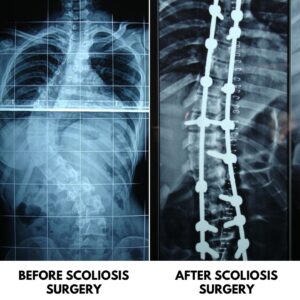
     

    Cjandana Scoliosis treatment


    Seven Hours That Changed Her Life

    The day of the surgery finally arrived. On the morning of the operation, Chandana surprised everyone with her calmness. As she was wheeled toward the operating room, she gripped her mother’s hand tightly. “It’s going to be okay,” she whispered. Her parents watched the doors of the operating theater close behind her. 

    For them, the next seven hours felt endless. Inside the operating theater, the surgical team carefully exposed the curved portion of her spine. One by one, pedicle screws were inserted into the vertebrae along the planned levels. The screws were connected with strong titanium rods. Using modern spinal deformity correction techniques, the surgeons gradually restored her spine to a balanced alignment while continuously monitoring the spinal cord and nerves throughout the procedure. The prominent rib hump, produced by the rotation of the spine was also addressed by removing a small portion of the affected ribs, allowing the rib cage to assume a more symmetrical contour. The surgery had gone exactly as planned. 

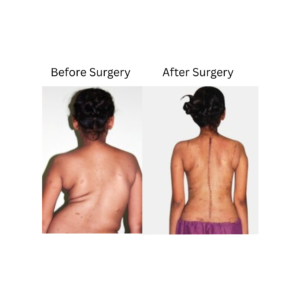
    When Chandana woke up in the recovery room, she was in considerable pain, as expected after such a major operation. Even before she opened her eyes fully, she sensed something different. For months, whenever she lay on her bed, her body had rested unevenly because of the twisted curve in her spine. Now, for the first time in over a year, her back rested flat against the mattress. She smiled. Without looking into a mirror, she knew. Her back was straight.


    Learning to Stand Tall Again

    The days following surgery were challenging. Every movement caused discomfort. Sitting up required courage. Standing seemed almost impossible. Yet Chandana  had already endured something far more painful than physical discomfort—the daily humiliation that had forced her to leave school and hide herself from the world. Compared with that emotional pain, the pain of recovery felt temporary.

    Her resilience amazed everyone around her. On the second postoperative day, with the support of the physiotherapy team, Chandana stood upright for the first time after surgery. A few hesitant steps soon became a slow walk along the hospital corridor. Watching their daughter walk with a straighter posture brought tears of joy to her parents’ eyes.

    Her recovery progressed remarkably well. The surgical wound healed uneventfully over the next two weeks, and each day she grew stronger, more confident, and more independent. Six weeks after surgery, Chandana returned to school. She wore the same uniform she had once been too afraid to put on. This time, she walked through the school gate with her shoulders relaxed and her head held high.

    Some classmates were surprised to see her. Others came forward to welcome her back. The cruel whispers had disappeared. The mocking voices were silent. There were no more catcalls. For the first time in over a year, Chandana walked through the school corridors without fear. She laughed with her friends again. She answered questions in class. The girl who had once hidden herself from the world was slowly learning to stand tall—not just physically, but emotionally.


    A New Beginning

    Years passed. Chandana completed her education, married, and built the life she had once feared she would never have. Today, she is the proud mother of two daughters and works at Brandix, where her dedication and sincerity earn her respect. She is financially independent, a loving wife, and a caring mother.
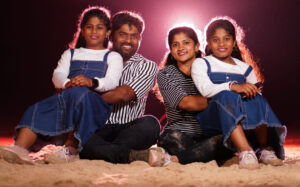
    Sometimes, while helping her daughters get ready for school, she remembers the morning when she herself refused to wear her school uniform. The memory no longer brings sadness. Instead, it fills her with gratitude—gratitude for her parents, who overcame their fears; gratitude for the doctors who treated her with skill and compassion; and gratitude for the opportunity to live the life she once thought she had lost. 


    More Than a Straight Spine

    People often ask Chandana what changed her life. They expect her to talk about the operation. Instead, she smiles. “The surgery straightened my spine,” she says. “But courage straightened my life.”

    Her parents, too, learned an unforgettable lesson. Fear had nearly prevented them from choosing the treatment their daughter needed. Looking back, they remain grateful that they ultimately placed their trust in expert medical advice rather than rumors and misconceptions.

    The scar on Chandana’s back remains. She has never tried to hide it. To others, it is simply a surgical scar. To Chandana , it is a symbol of courage, resilience, and a second chance at life. Her journey is not merely about scoliosis surgery.

    It is about a young girl whose dreams were interrupted by a spinal deformity, whose confidence was shattered by cruelty, and whose future was restored through timely diagnosis, compassionate medical care, unwavering family support, and extraordinary determination.

    Today, when people meet Chandana, they do not see scoliosis. They see a confident woman. A devoted wife. A caring mother. Few realize that years earlier, this same girl had been too frightened to walk out of her own front door.

    This is the story of Chandana—a young girl who refused to let a curve define her future and chose to stand tall for the rest of her life.

    Spine Leela Logo

    Dr. B. Leela Prasad is one of the country’s most renowned orthopedic doctors, with over 15 years of experience in the field. After earning his medical degree from Andhra Medical College, Visakhapatnam, he pursued post-graduation in Orthopedics at Guntur Medical College.

    Visit Us at

  • Common Myths About Scoliosis – And the Truth

    Common Myths About Scoliosis – And the Truth

    Common Myths About Scoliosis

    Home > Blog > Common Myths About Scoliosis

    Scoliosis Treatment in Vizag

    Common Myths About Scoliosis

    Scoliosis is one of the most misunderstood spinal conditions. Many patients and families have concerns based on information they hear from friends, relatives, or social media. Understanding the facts can help patients make informed decisions about diagnosis, treatment, and long-term spine health.


    🔹 Myth 1: “Carrying heavy school bags/backpacks causes scoliosis.”
    Truth: Carrying heavy school bags may cause temporary back or shoulder pain, but it does not cause scoliosis.

    A heavy bag can strain muscles, but it will not permanently change the shape of the spine.


    🔹 Myth 2: “Scoliosis is caused by poor posture.”

    Truth: Poor posture does not cause scoliosis. Slouching may make asymmetry more noticeable, but it does not create a structural spinal curve.


    🔹 Myth 3: “Scoliosis only affects girls.”

    Truth: Both boys and girls can develop scoliosis . However, girls are more likely to have curves that progress and require treatment.


    🔹 Myth 4: “Scoliosis always causes visible deformity.”

    Truth: Many scoliosis curves are mild and barely noticeable. Possible signs include uneven shoulders, rib prominence, or waist asymmetry, but not everyone has obvious physical changes.


    🔹 Myth 5: “Scoliosis is painful.”

    Truth: Scoliosis in children and adolescents is usually painless. Pain is more common in adults with long-standing curves or degenerative changes, but many people with scoliosis live completely pain-free.


    🔹 Myth 6: “Scoliosis can be corrected by exercise and physiotherapy.”

    Truth: Exercise and physiotherapy improve strength, posture, and comfort, but they usually do not permanently straighten a structural curve.

    Specialized programs such as the Schroth method may help manage progression and improve symmetry, but they are not a guaranteed cure.


    🔹 Myth 7: “Braces cure scoliosis.”

    Truth: Bracing does not cure scoliosis. It helps prevent the curve from worsening while a child is still growing.


    🔹 Myth 8: “Everyone with scoliosis needs surgery.”

    Truth: Surgery is recommended only for severe or rapidly progressing curves. Most patients are either monitored regularly or treated with bracing.


    🔹 Myth 9: “If you need surgery, you’ll never be active again.”

    Truth: Most patients return to sports, dance, and everyday activities within a few months after surgery.

    Although procedures such as spinal fusion may reduce flexibility in treated segments, patients are generally encouraged to remain active once healing is complete.


    🔹 Myth 10: “Females cannot have normal childbirth after scoliosis surgery.”

    Truth: Most women who undergo scoliosis correction surgery can conceive normally, carry pregnancy safely, and deliver vaginally.

    Scoliosis surgery does not affect the uterus, ovaries, or hormonal function, so fertility is typically unaffected.


    🔹 Myth 11: “Children stop growing taller after scoliosis correction surgery.”

    Truth: Children do not automatically stop growing after scoliosis surgery.

    Most procedures are performed near or after the adolescent growth spurt, when most spinal growth is already complete.

    Many children actually become taller immediately after surgery because the curved spine is straightened.

    Spinal fusion stops growth only in the fused segments. Growth of the unfused spine, legs, and the rest of the body continues until skeletal maturity.

    Important:
    In very young children with early-onset scoliosis, surgeons may use growth-friendly techniques instead of full fusion to allow continued spinal growth.

    🔹 Myth 12: “Scoliosis surgery is very risky and often causes serious complications like paralysis.”

    Truth: Scoliosis correction is a complex procedure, but with modern techniques and intraoperative monitoring, it is considered safe when performed by experienced spine deformity surgeons.

    Serious complications such as paralysis are very rare.


    🔹 Myth 13: “Complex spine surgeries can only be done in major metropolitan cities.”

    Truth: In the past, scoliosis correction was largely concentrated in metropolitan centers due to the need for highly specialized surgeons, advanced ICUs, experienced anesthesia teams, and specialized instrumentation.

    Over the past decade, spine care has advanced significantly. Surgical expertise, modern technology, and advanced hospital infrastructure are now available in many Tier-2 cities.

    As a result, complex spine surgeries such as scoliosis correction can be safely and successfully performed in well-equipped centers, including Visakhapatnam, provided the necessary expertise, technology, and multidisciplinary support are available.

    Looking for scoliosis treatment?
    Consult Dr. B. Leela Prasad , an experienced spine surgeon in Visakhapatnam, for expert evaluation and personalized treatment.

    Common Myths About Scoliosis — Dr. B. Leela Prasad | Spine Specialist, Visakhapatnam

    Dr. B. Leela Prasad specializes in the diagnosis and treatment of scoliosis, spinal deformities, and complex spine disorders. With advanced surgical expertise and modern treatment approaches, patients receive comprehensive care for long-term spinal health, improved posture, and enhanced quality of life.

    Spine Leela Logo

    Dr. B. Leela Prasad is one of the country’s most renowned orthopedic doctors, with over 15 years of experience in the field. After earning his medical degree from Andhra Medical College, Visakhapatnam, he pursued post-graduation in Orthopedics at Guntur Medical College.

    Visit Us at

  • Scoliosis: All you need to know

    Scoliosis: All you need to know

    Scoliosis: All you need to know

    What is Scoliosis

    Scoliosis is a structural spinal disorder in which the spine curves sideways rather than remaining straight. Normally, the spine has gentle front-to-back curves that help maintain balance and absorb shock. In scoliosis, however, there is a side-to-side curvature, often accompanied by rotation of the vertebrae.

    The condition is most commonly detected in children and adolescents, particularly during periods of rapid growth, although it can affect individuals of any age. Earlier consultation for scoliosis treatment from an expert doctor can help you understand more about the condition, treatment, and medication.

    Types and causes

    • Adolescent idiopathic scoliosis: This is the most common type, accounting for nearly 80% of cases. It develops during adolescence and occurs more frequently in girls. Although the exact cause remains unknown, genetic, hormonal, and neuromuscular factors are believed to contribute.
    • Congenital scoliosis: This results from abnormal vertebral development during fetal growth. The vertebrae may be fused, missing, or incompletely formed.
    • Neuromuscular scoliosis: It arises secondary to conditions such as cerebral palsy, muscular dystrophy, or spinal cord injury, in which weakened or imbalanced muscles are unable to provide adequate support to the spine.
    • Degenerative scoliosis: It develops in older adults as a result of age-related wear and tear of the intervertebral discs and facet joints, leading to progressive spinal curvature.

    Symptoms

    Symptoms vary depending on the severity of the curvature.

    Visible Signs:

    • Uneven shoulders
    • Tilted waistline
    • One hip higher than the other
    • Rib prominence when bending forward

    Mild cases may go unnoticed and are often detected during routine screening.

    Children and adolescents typically do not experience pain. However, adults may report pain and stiffness of the back.

    In severe cases, significant curvature can reduce chest cavity space, potentially causing breathing difficulties and, rarely, impaired heart function.

    Scoliosis Treatment

    Diagnosis and Imaging

    Scoliosis is typically diagnosed by a physical examination. The spinal curvature becomes more apparent when the patient is asked to bend forward, a maneuver known as the forward bend test.

    X-rays are used to confirm the diagnosis and to measure the severity of the curvature using the Cobb angle. Curves less than 20 degrees are generally classified as mild, those between 20 and 40 degrees as moderate, and curves greater than 40–50 degrees as severe.

    MRI scans are done to rule out underlying abnormalities of the spinal cord.

    Follow-Up and Risk of Progression

    • Growing children require regular follow-up, typically with X-rays every six months, to monitor changes in the spinal curvature.
    • The risk of curve progression depends on several factors, including the child’s age, remaining growth potential, and the magnitude of the curve at the time of diagnosis.

    Treatment

    Treatment depends on:

    • Curve severity
    • Patient’s age
    • Remaining growth
    • Risk of progression

    Mild curves in adolescents who have completed growth often require no active treatment but should be monitored.


    Bracing

    It is a key treatment option for moderate scoliosis, particularly in children and adolescents who are still growing. While braces do not correct or straighten the spine, they are effective in preventing further progression of the curve. For optimal effectiveness, the brace must be worn for about 20 hours per day. They are usually worn under clothing. Children wearing braces can continue to participate in most daily activities, and once growth is complete, bracing may no longer be necessary.

    Surgical Correction

    Surgery is generally recommended for:

    • Curves greater than 50°
    • Curves likely to progress despite conservative management

    The procedure typically involves:

    • Placement of titanium screws in vertebrae
    • Connecting the screws with rods to correct alignment
    • Correcting the deformity with controlled manoevers
    • Bone grafting to achieve spinal fusion

    Fusion stabilises the spine and prevents further worsening of the curve.

    Complications of Surgery

    Scoliosis correction is a major surgical procedure with potential risks and complications.

    Immediate Complications:

    • Significant blood loss
    • Weakness or paralysis due to spinal cord injury
    • Anaesthesia-related complications
    • Need for postoperative ICU care
    • Implant-related problems
    • Wound infection

    Late Complications:

    • Progression above or below the fused segment
    • Delayed wound infection

    The risk of surgical complications can be reduced through meticulous planning and the surgeon’s skill and experience in execution.

    Lifestyle and Supportive Care

    Non-medical measures play an important supportive role:

    • Physical therapy to improve muscle balance and posture
    • Core strengthening exercises
    • Swimming, yoga, and Pilates for flexibility and fitness
    • Psychological support for body image concerns and emotional well-being

    Adolescents may experience stress or self-consciousness, making emotional support essential.

    Outlook

    Scoliosis is no longer considered a disabling condition. With modern medical and surgical advancements, individuals with scoliosis can lead active, productive lives. Women can safely bear children, even after corrective surgery.

    Effective treatment is now available in many well-equipped hospitals, not just major metropolitan centers.

    Why Choose Spine Leela for Scoliosis Treatment in Vizag?

    Choosing treatment with Dr. B. Leela Prasad at Spine Leela for scoliosis treatment in Vizag is one of the best decisions for patients seeking expert spine care. With extensive experience in diagnosing and managing spinal deformities, he provides personalized treatment plans tailored to each patient’s condition and age.


    At Spine Leela, advanced diagnostic tools, modern surgical techniques, and compassionate care ensure safe, effective, and long-term results for scoliosis patients in Vizag.


    Spine Leela Logo

    Dr. B. Leela Prasad is one of the country’s most renowned orthopedic doctors, with over 15 years of experience in the field. After earning his medical degree from Andhra Medical College, Visakhapatnam, he pursued post-graduation in Orthopedics at Guntur Medical College.

    Visit Us at