What is Scoliosis
Scoliosis is a structural spinal disorder in which the spine curves sideways rather than remaining straight. Normally, the spine has gentle front-to-back curves that help maintain balance and absorb shock. In scoliosis, however, there is a side-to-side curvature, often accompanied by rotation of the vertebrae.
The condition is most commonly detected in children and adolescents, particularly during periods of rapid growth, although it can affect individuals of any age. Earlier consultation for scoliosis treatment from an expert doctor can help you understand more about the condition, treatment, and medication.
Types and causes
- Adolescent idiopathic scoliosis: This is the most common type, accounting for nearly 80% of cases. It develops during adolescence and occurs more frequently in girls. Although the exact cause remains unknown, genetic, hormonal, and neuromuscular factors are believed to contribute.
- Congenital scoliosis: This results from abnormal vertebral development during fetal growth. The vertebrae may be fused, missing, or incompletely formed.
- Neuromuscular scoliosis: It arises secondary to conditions such as cerebral palsy, muscular dystrophy, or spinal cord injury, in which weakened or imbalanced muscles are unable to provide adequate support to the spine.
- Degenerative scoliosis: It develops in older adults as a result of age-related wear and tear of the intervertebral discs and facet joints, leading to progressive spinal curvature.
Symptoms
Symptoms vary depending on the severity of the curvature.
Visible Signs:
- Uneven shoulders
- Tilted waistline
- One hip higher than the other
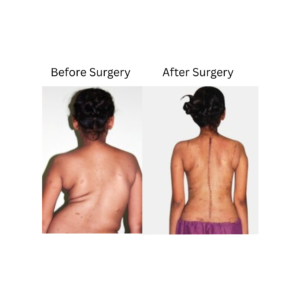
- Rib prominence when bending forward
Mild cases may go unnoticed and are often detected during routine screening.
Children and adolescents typically do not experience pain. However, adults may report pain and stiffness of the back.
In severe cases, significant curvature can reduce chest cavity space, potentially causing breathing difficulties and, rarely, impaired heart function.
Diagnosis and Imaging
Scoliosis is typically diagnosed by a physical examination. The spinal curvature becomes more apparent when the patient is asked to bend forward, a maneuver known as the forward bend test.
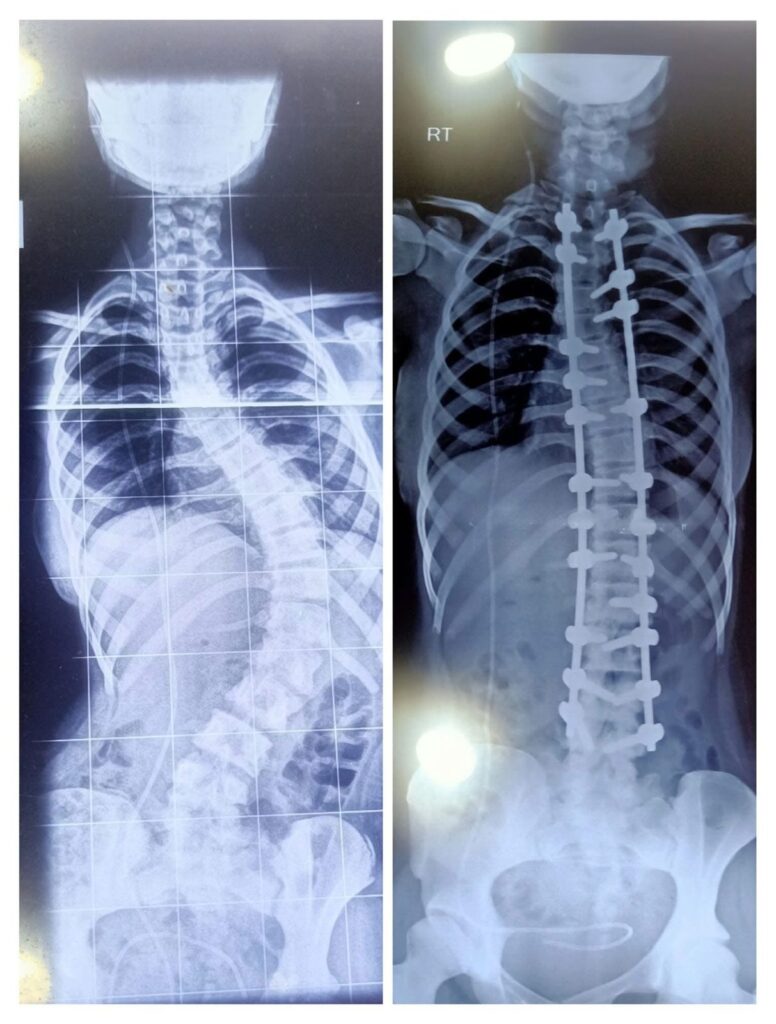
X-rays are used to confirm the diagnosis and to measure the severity of the curvature using the Cobb angle. Curves less than 20 degrees are generally classified as mild, those between 20 and 40 degrees as moderate, and curves greater than 40–50 degrees as severe.
MRI scans are done to rule out underlying abnormalities of the spinal cord.
Follow-Up and Risk of Progression
- Growing children require regular follow-up, typically with X-rays every six months, to monitor changes in the spinal curvature.
- The risk of curve progression depends on several factors, including the child’s age, remaining growth potential, and the magnitude of the curve at the time of diagnosis.
Treatment
Treatment depends on:
- Curve severity
- Patient’s age
- Remaining growth
- Risk of progression
Mild curves in adolescents who have completed growth often require no active treatment but should be monitored.
Bracing
It is a key treatment option for moderate scoliosis, particularly in children and adolescents who are still growing. While braces do not correct or straighten the spine, they are effective in preventing further progression of the curve. For optimal effectiveness, the brace must be worn for about 20 hours per day. They are usually worn under clothing. Children wearing braces can continue to participate in most daily activities, and once growth is complete, bracing may no longer be necessary.
Surgical Correction
Surgery is generally recommended for:
- Curves greater than 50°
- Curves likely to progress despite conservative management
The procedure typically involves:
- Placement of titanium screws in vertebrae
- Connecting the screws with rods to correct alignment
- Correcting the deformity with controlled manoevers
- Bone grafting to achieve spinal fusion
Fusion stabilises the spine and prevents further worsening of the curve.
Complications of Surgery
Scoliosis correction is a major surgical procedure with potential risks and complications.
Immediate Complications:
- Significant blood loss
- Weakness or paralysis due to spinal cord injury
- Anaesthesia-related complications
- Need for postoperative ICU care
- Implant-related problems
- Wound infection
Late Complications:
- Progression above or below the fused segment
- Delayed wound infection
The risk of surgical complications can be reduced through meticulous planning and the surgeon’s skill and experience in execution.
Lifestyle and Supportive Care
Non-medical measures play an important supportive role:
- Physical therapy to improve muscle balance and posture
- Core strengthening exercises
- Swimming, yoga, and Pilates for flexibility and fitness
- Psychological support for body image concerns and emotional well-being
Adolescents may experience stress or self-consciousness, making emotional support essential.
Outlook
Scoliosis is no longer considered a disabling condition. With modern medical and surgical advancements, individuals with scoliosis can lead active, productive lives. Women can safely bear children, even after corrective surgery.
Effective treatment is now available in many well-equipped hospitals, not just major metropolitan centers.
Why Choose Spine Leela for Scoliosis Treatment in Vizag?
Choosing treatment with Dr. B. Leela Prasad at Spine Leela for scoliosis treatment in Vizag is one of the best decisions for patients seeking expert spine care. With extensive experience in diagnosing and managing spinal deformities, he provides personalized treatment plans tailored to each patient’s condition and age.
At Spine Leela, advanced diagnostic tools, modern surgical techniques, and compassionate care ensure safe, effective, and long-term results for scoliosis patients in Vizag.
